
How provinces produce
Every province you own contributes to your country through its buildings. Production is credited on real-hour timing on the server, so income keeps arriving whether or not you have the app open. That makes development the quietest and most important part of the game: an hour of construction you start before bed pays out every hour afterwards, and an hour you forget to start is gone.
Resources are tied to the campaign server you are playing on. What a province produces stays in that campaign and can only be spent there. If you play on two servers, you are running two independent economies.
Tap any province you own and open its details. The panel shows ownership, the buildings it contains and the hourly production it currently delivers. That panel is the authority. Production values are tuned between releases, so the number you remember from last month may not be the number the server pays today.
Recent production changes and how to read them
Production rates were recently rebalanced: Gold produced by economy buildings was reduced sharply, and output of the other resources was also lowered. The change applies to income produced from that point forward; it does not reach back into balances you already held.
The practical lesson is that buildings which produce Gold are no longer a shortcut to a large Gold balance. Treat them as one input among several and judge each upgrade by what the panel says it adds per hour against what it costs today.
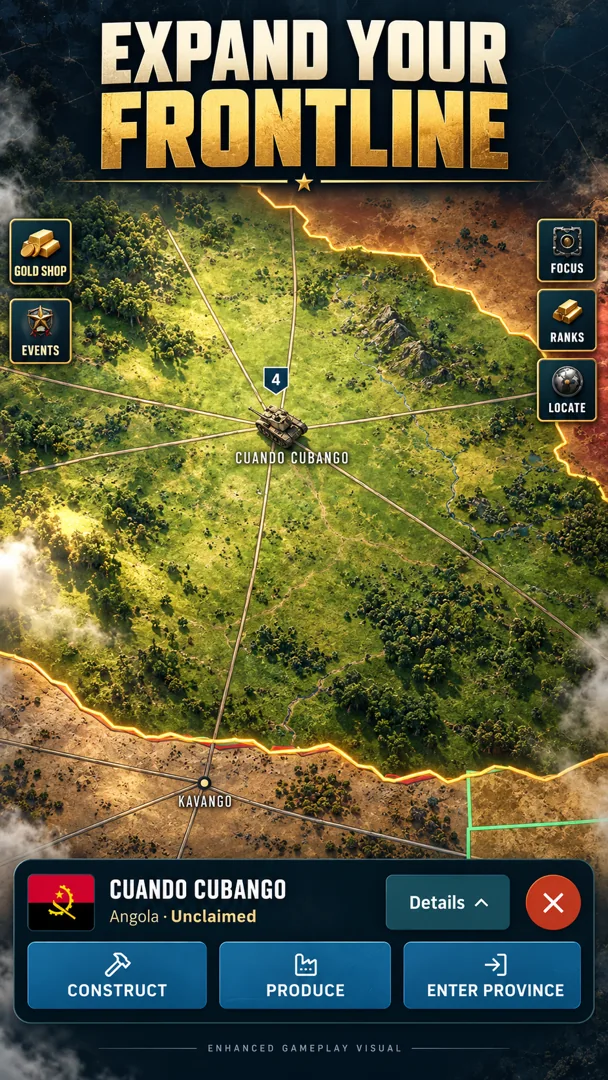
Enhanced gameplay visual — retouched, not a raw screenshot
A construction order that works
New commanders tend to build whatever looks exciting first. A steadier order is to raise income, then the facilities that unlock units, then defence where the map tells you it is needed.
- Income buildings in your safest provinces. Your core provinces, especially those behind your capital, are least likely to be captured, so they are the best place for long-term investment.
- One facility per unit family you actually intend to use. Airstrips unlock aircraft, coastal Ports unlock ships, and Hangars support basing and refuelling. Do not build a Port inland or a second Airstrip before the first one has a purpose.
- Fortresses on the border you share with active neighbours. A Fortress protects friendly troops physically inside that province; it does nothing for armies elsewhere.
- Research that unlocks the next level you need. Research raises the level you are allowed to build or train. It does not hand you finished units or buildings.
The shared training slot
Recruitment draws on a single training slot shared across your country on that server. Building ten facilities does not give you ten parallel queues. What it gives you is choice about what goes into the one queue you have.
That makes sequencing the real skill. Before you log off, queue the longest useful job. When you are online and reacting to a threat, queue the shortest unit that answers it. A queue that sits empty for six hours while you sleep is the most expensive mistake in the early game.
Research unlocks levels, not armies
Research is easy to misunderstand. Completing a research item raises the level available to you for a unit or building line. You then still need to build or train at that level, paying the normal cost and waiting the normal time.
Plan research one step ahead of construction. If you will want higher-level aircraft in two days, start the relevant research now so the level is available by the time your Airstrip and resources are ready.
Protecting your investment
Provinces can be captured. When a province changes owner, unfinished jobs there are lost without a refund. That single rule should shape where you build: keep long, expensive jobs in provinces that are hard to reach, and keep border provinces lean until you can defend them.
Your original capital always remains yours and cannot be captured, but troops stationed there can still be attacked and destroyed. It is a safe economic anchor, not a safe army park.
Daily development checklist
Use this routine once or twice a day. It takes a few minutes and compounds over a campaign.
- Open each core province and confirm every building slot is either working or deliberately idle.
- Read the live hourly output before choosing an upgrade; compare cost against gain.
- Queue the longest useful training job before logging off.
- Start the research that unlocks the next level you will need, not the one you need right now.
- Check border provinces for enemy contacts before starting long jobs there.
- Collect any rewards in Mail Events and System Mail so resources are actually credited before you plan spending.
Mistakes that slow an economy
Most weak economies are not unlucky. They usually come from a few repeated habits.
Common mistakes
- Building on the frontier first. A captured province takes unfinished jobs with it. Develop the interior first.
- Planning from remembered rates. Rates were rebalanced recently and may change again. Read the panel.
- Expecting research to deliver units. It unlocks a level. You still build and train.
- Leaving the training slot empty overnight. One slot per country means every idle hour is lost output.
- Treating Gold buildings as the main Gold source. Their output was reduced. Judge them like any other upgrade.
Scenario: a coastal start under pressure
The situation below is a common early shape on a crowded server, and the reasoning behind each choice generalises to most starts.
Field scenario
Two neighbours, one coastline
You hold a coastal country with a land border to two players. In the first hours, raise income in the provinces farthest from both borders and build a single Port on the safest stretch of coast. Queue ground troops for the border while the Port completes, then research toward the first ship level you want. Do not upgrade the border provinces yet. Once you know which neighbour is active, add a Fortress on that side only.
Continue the field manual
Next: Events, rewards and mail · Back: Economy and research