
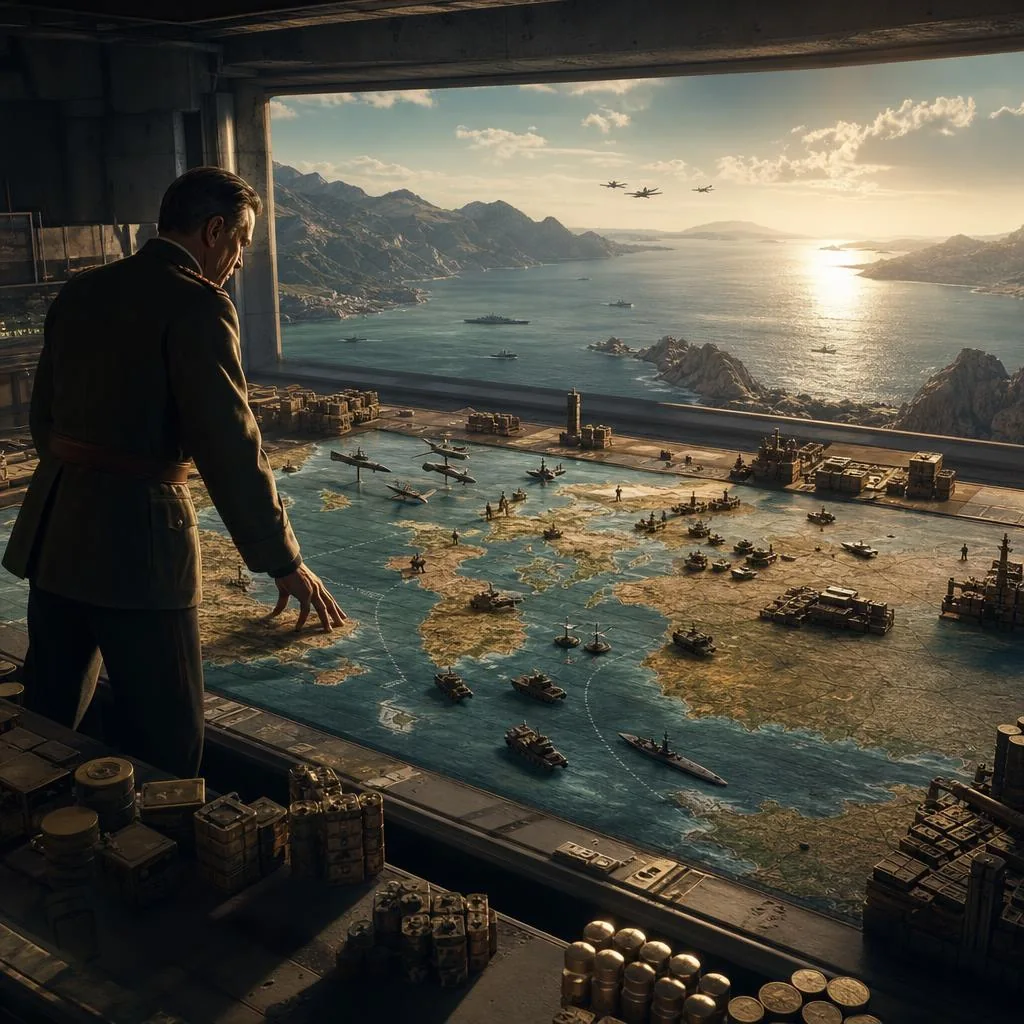
An honest starting point
Every year a new wave of lists promises the best Android war strategy games, and every year most of them rank the same handful of titles by download count. We are the team that makes WW3: Sovereign Command, so we are not going to pretend to be a neutral reviewer or invent a leaderboard with our game at the top. What we can do is explain plainly what this game is, who it suits, and what you would actually be doing in your first week. If that sounds like the war strategy game you have been looking for in 2026, it is worth a look. If not, you will know quickly, and that is useful too.
WW3: Sovereign Command is a persistent, world-scale real-time strategy game. You claim one country on a live campaign server and run it: provinces, production, research, commanders, ground forces, tanks, jets and ships, and diplomacy with the real people who hold the countries around you. The world keeps moving while you are away. Construction finishes, marches arrive and neighbours make decisions on their own schedule.
What makes it different from typical mobile war games
A lot of mobile strategy is a base-builder with a battle screen bolted on. Here, the map is the game. Your country is a real shape on a world map, your roads are real routes, and your starting coastline shapes your early naval options, although an inland commander can still capture a coast later. Choosing a country is a strategic decision, not a cosmetic one.
The second difference is that rules are physical rather than abstract. An army has to be somewhere. It travels along roads, across water or through the air, and it can be seen or not seen. Targeting an enemy requires current sight; being within weapon distance on paper is not enough. Jets carry a 3,000 km fuel tank, fly one-hour patrols and then return to a Hangar. A transport must be within 200 km of the coast for troops to disembark; they land at the shoreline and then march inland, rather than appearing deep in enemy territory. These constraints make the game slower to master and far more satisfying when a plan comes together.
Third, it is honest about money. Gold and every other resource are server-local. If you buy Gold, it lands on the server you choose and stays in that campaign. Nothing is spent automatically, including in the tutorial, which runs on your real campaign so that the lessons are not a disposable sandbox.
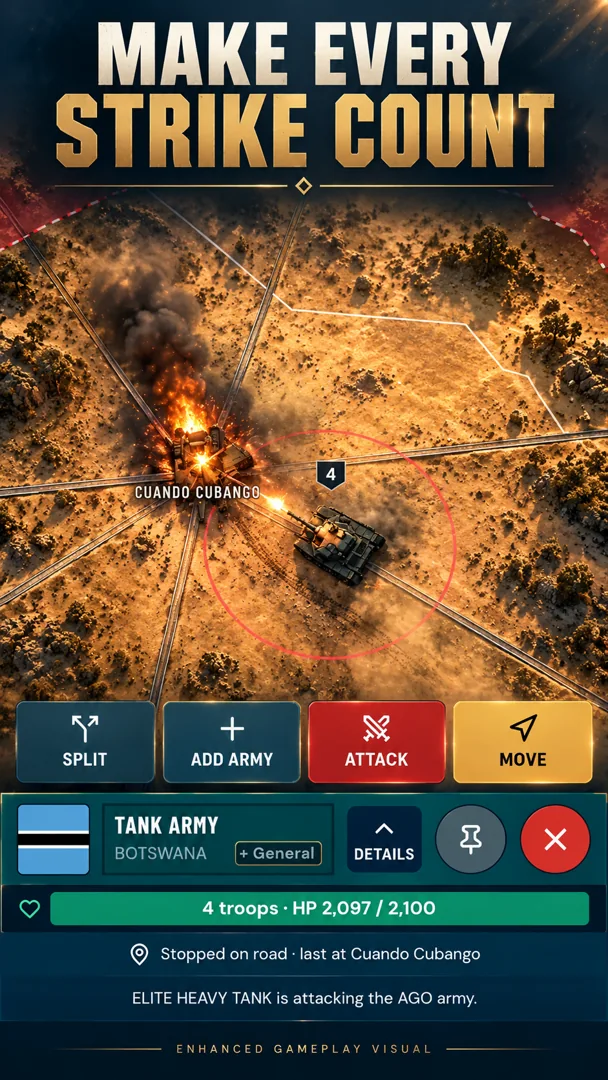
Enhanced gameplay visual — retouched, not a raw screenshot
Your first day: tactics that actually matter
The first hours set the economic curve for the whole campaign, and most of the important choices are boring ones. That is a good sign.
- Pick a country you can defend. A coastline gives you a future navy. A short land border gives you fewer early threats. A country wedged between three active players is a hard start, however tempting its size.
- Build income in the interior first. Captured provinces lose their unfinished jobs without refund, so long investments belong behind your capital, not on the frontier.
- Never leave the training slot empty. Recruitment uses one shared slot per country. Queue the longest useful job before you put the phone down.
- Research one step ahead. Research unlocks higher levels; it does not deliver units. Start the research you will need tomorrow, today.
- Claim your mail. Rewards arrive as mail, in Mail Events or System Mail depending on where they come from, and become yours only when you claim them.
The getting started guide and province development guide walk through these steps with checklists.
Thinking in campaigns, not sessions
Because the server never pauses, the best players think about what will happen while they are offline. Before a break, ask three questions. What will finish while I am away? What could reach me while I am away? And what will I want ready when I come back?
Your original capital is always yours and cannot be captured, which gives every commander a permanent anchor. But troops stationed in it can still be attacked, so a capital is a safe economy, not a safe place to park your whole army. Spread a reserve between the capital and a Fortress province on your most active border.
Production rates are tuned by the live server. Gold production from economy buildings was recently reduced substantially and other output was lowered as well, which applies to income from that point on. The practical advice is simple: read the live building panel before every upgrade rather than planning from a remembered table.
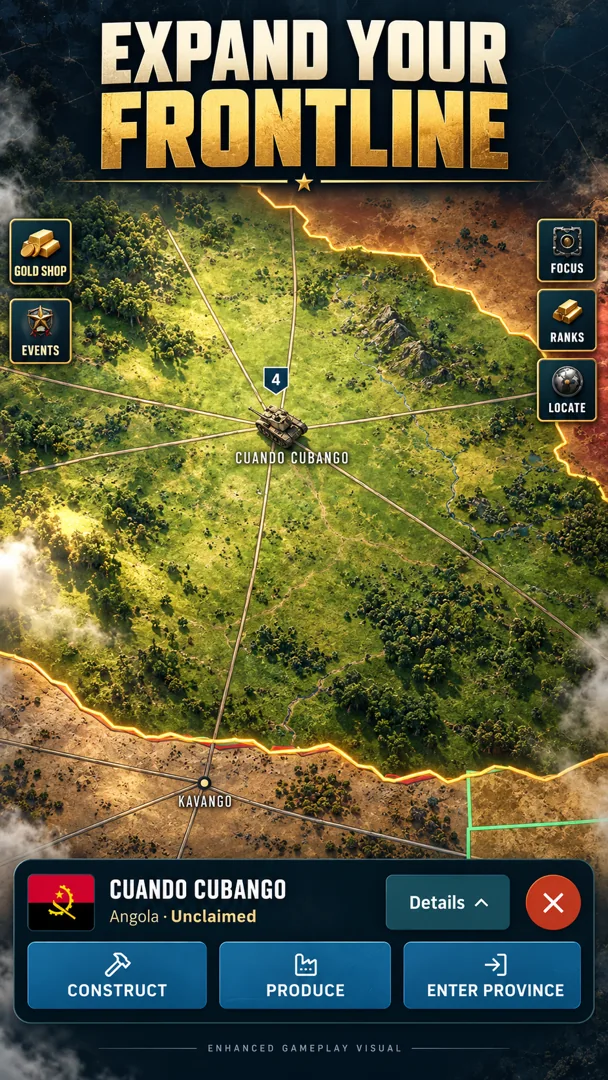
Enhanced gameplay visual — retouched, not a raw screenshot
Ground war: concentration beats sprawl
Formations matter. A formation is a stack of troops that moves and fights as one, and a general assigned to it applies bonuses such as attack, damage or health to the whole formation. Armies that arrive one at a time can be engaged one at a time, so concentrating or coordinating arrival is often worth the extra minutes.
Movement is not capture. To take a province you issue an explicit Capture order, and your troops must reach the province centre while accounting for defenders. Marching through a province changes nothing about its ownership. In Contested Land the rules tighten further: ground units enter only across nine bridges, move through the interior, and capture is disabled entirely. Exact weapon ranges and speeds can be tuned, so read the live unit details for your selected army rather than relying on a number from a forum.
For more, read army movement, commanders and formations and combat range and targeting.
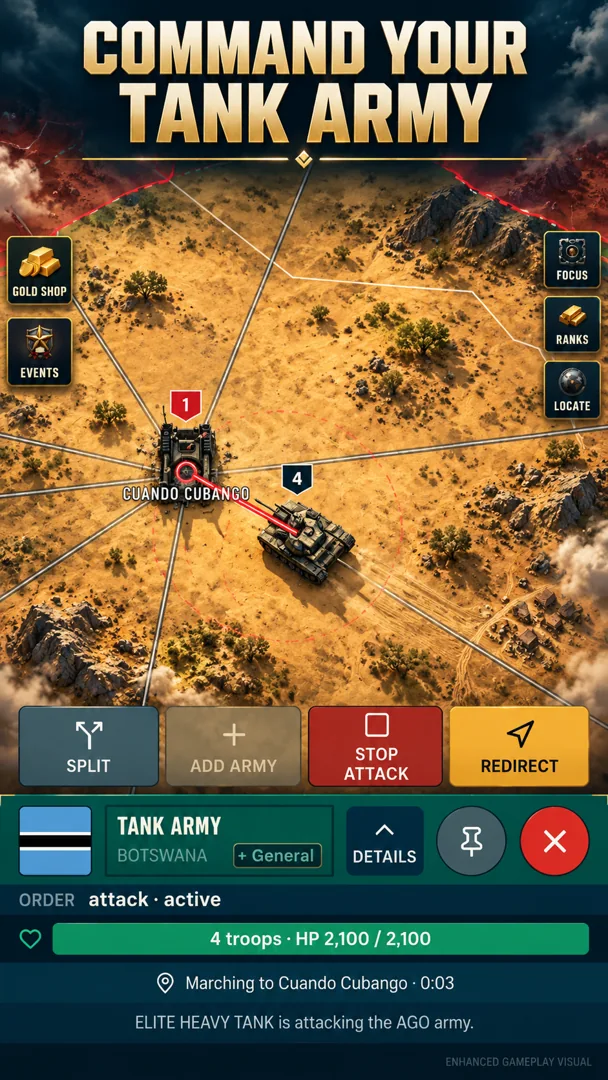
Enhanced gameplay visual — retouched, not a raw screenshot
Air power without the guesswork
Jets are the most misunderstood system in the game, so it is worth being precise. Jets have no defence toggle and do not fire automatically while idle. They act when you send them on a patrol or give them a manual attack order. A patrol lasts one hour; afterwards the jet returns to a Hangar. The fuel tank holds 3,000 km, which covers the outbound leg, time on station and the return. Optional refuelling costs 5,000 Gold per jet, and you never need it to learn the system.
The rule that catches people out is that targeting still requires sight. A jet with fuel to spare cannot attack something your country cannot currently see. Pair air missions with scouting or alliance vision, and plan the return before the launch. The aircraft and naval guide has a full mission checklist.
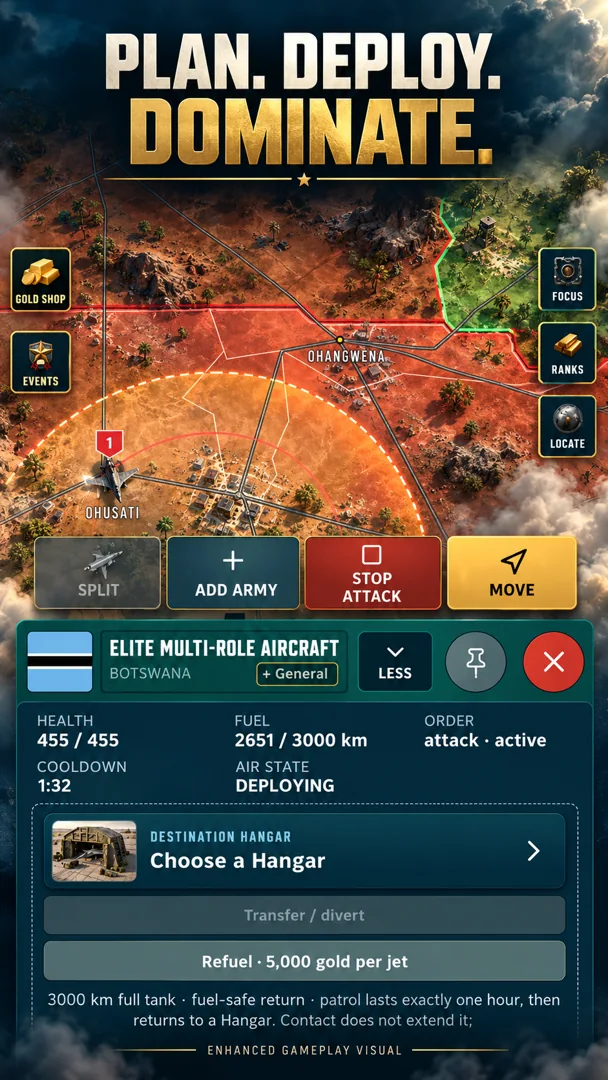
Enhanced gameplay visual — retouched, not a raw screenshot
Naval operations: the coast is a door, not a wall
Ships come from coastal Ports and sail on water. For an amphibious operation, troops board before the transport sails. The transport must come within 200 km of the coast to disembark them; the troops land at the shoreline, and from there they march inland like any other ground force. There is no shortcut that drops an army in the middle of a continent, so choose landing beaches that sit close to your real objective and that the enemy is not already watching.
Antarctica is permanently unplayable. Do not plan landings, routes or bases there; it will only waste a voyage.
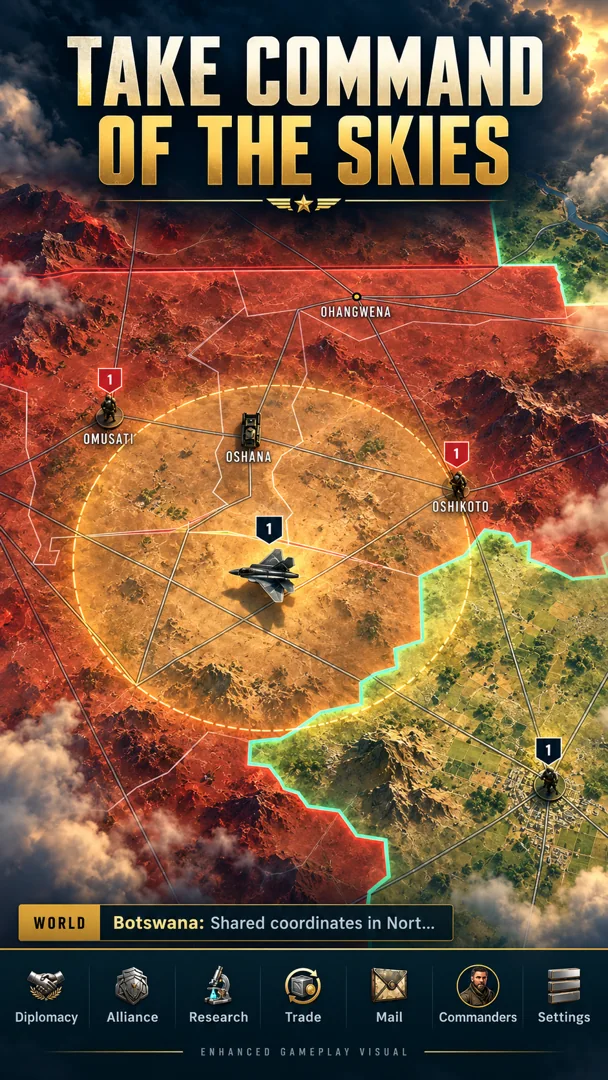
Enhanced gameplay visual — retouched, not a raw screenshot
Economy and trade: the quiet multiplier
Your economy is the slowest system to build and the hardest to recover once neglected. Beyond construction, the Trade Exchange lets you swap surpluses with other countries on the same campaign. Offers last 6, 12 or 24 hours, the offered resources are reserved while the offer is open, and cancelling returns them. Trade what you do not need this week, never what your next build depends on.
Events add another layer. Rogue formations drop loot only when the complete formation is defeated, and a solo kill counts. Competitive events such as the current kill event list Gold prizes of 100,000, 50,000 and 20,000 for top placements, paid through Mail Events and claimed once. The events guide covers the details.
Alliances: shared sight is a weapon
Diplomacy has distinct layers, and treating them as the same thing causes real losses. An alliance shares vision and territory: allied land appears blue, there is no friendly fire and allies cannot capture each other's provinces. Friendship is narrower. Friends agree not to fight, but friends do not share sensors with you. A non-aggression pact is separate again, and NAP partners show grey relationship markers on their army shields.
Shared alliance vision is one of the most powerful tools in the game, because it solves the sight problem for jets and artillery-style attacks. A small alliance of active commanders who coordinate their borders will usually outlast a larger, quieter one. Private messages help, but a message is not a guarantee, so keep your own scouting honest. See diplomacy and campaigns.
Who this game is for, and who it is not for
WW3: Sovereign Command suits players who enjoy thinking before tapping, who like a map that rewards geography, and who want decisions that still matter tomorrow. It suits people with a few short check-ins a day as much as long sessions, because good queueing and good positioning do the work while you are away.
It is probably not the game for you if you want instant matches that reset every ten minutes, or if you prefer a single-player campaign with a fixed ending. That is not a weakness; it is simply a different kind of strategy game.
How to start well
Create an account, open the game and join a server. Read the first three guides in the guide library while your first buildings complete. Keep the training slot busy, claim your mail, and choose your first neighbour to talk to before choosing your first neighbour to fight. That is most of what separates a strong first week from a frustrating one.
If you are comparing the best Android war strategy games this year, we hope this gives you an accurate picture of what we have built. Then the best test is your own first campaign.